
The 7 best residential proxies for 2026 — tested for price and reliability
Pricing a residential proxy in 2026 means sorting through more than fifty vendors, ten KYC policies, and a $1 to $15-per-gigabyte price spread that makes no sense at first glance. We bought traffic on seven of them — Bright Data, Decodo, IPRoyal, Oxylabs, ProxyLane, SOAX, and DataImpulse — and tested each for a month on the same scraping job. This ranking is the cheapest path through each provider's plans, not the headline rate. Affiliate links are flagged ↗; the picks were not.
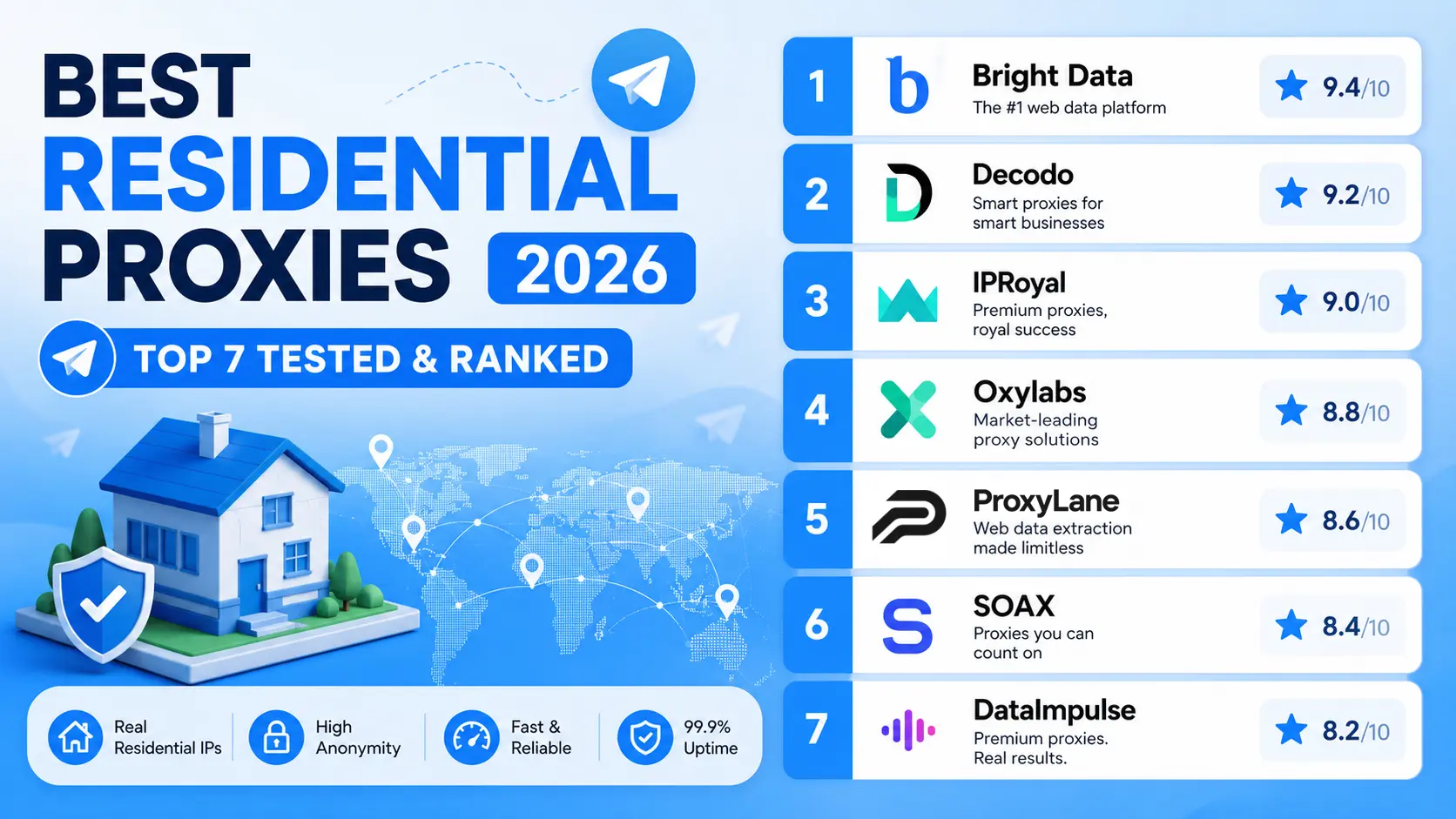
Bright Data is the most complete network; Decodo is the best mid-volume value at about $2.20/GB; IPRoyal is the cheapest legitimate pay-as-you-go at $1.75/GB.
- Bright Data and Oxylabs cover every country and feature, but you pay $4–$8/GB at entry.
- Decodo and SOAX hit $2.20–$4.95/GB at mid-volume; IPRoyal sits at $1.75/GB pay-as-you-go.
- DataImpulse is the cheapest legit option at $1/GB flat; ProxyLane is the login-safe pick from $2/GB, with 72-hour sticky sessions and a $1.95 trial.
What is a residential proxy in 2026?
A residential proxy is an IP address borrowed from a real home internet connection — you buy gigabytes, the provider routes your traffic through that real-user IP.
That is the whole product. Everything else — pool size, country menu, sticky sessions, SOCKS5 support — is how providers compete on top of that core idea.
The IPs come from two main sources. The clean source: SDK partnerships where end-users opt in to share bandwidth in exchange for free apps or VPN access. The grey source: bundled SDKs people did not really notice they agreed to. The bigger providers — Bright Data, Oxylabs, Decodo — publish full compliance pages explaining how they source IPs and which users they will not route through. Cheaper providers are vaguer.
Most pricing is metered in gigabytes of upload+download, not in IP count. A single IP can carry one request or ten thousand; what costs money is the bandwidth. That is why $1/GB at DataImpulse and $8/GB at Oxylabs's pay-as-you-go tier are not eight different products — they are roughly the same product at very different margins.
A 'sticky' session pins the same IP for 1, 10, or 30 minutes; a 'rotating' session swaps the IP on every request. Telegram automation, multi-account work in antidetect browsers, and account creation all need sticky sessions. SERP scraping and price monitoring usually do not.
Why pay for residential proxies instead of datacenter IPs?
Because datacenter IPs get blocked. Most large sites — Instagram, TikTok, retail, ticketing — carry a blocklist of known datacenter ranges, and residential IPs do not trigger that signal.
- Telegram MTProto and antidetect work: Telegram bans by IP + device fingerprint. Switching to a residential IP per account cuts ban rates sharply in our tests.
- Social media account warm-up: Instagram, TikTok, X all fingerprint datacenter IPs on signup. Residential IPs survive the first 7 days; datacenter IPs rarely do.
- SERP and price scraping: Google, Amazon, and most retail sites quietly downrank or A/B-test datacenter ranges. Residential traffic gets the same page real shoppers see.
- Ad verification and brand protection: Checking how your ad renders in São Paulo or Jakarta requires an IP from there. Datacenter ranges are excluded from most ad networks.
- Geo-locked content QA: Streaming, regional pricing, and city-level deals only render on residential IPs from the right city.
How do you set up a residential proxy in under five minutes?
Every provider in this list ships the same three things: an HTTP/HTTPS gateway, a SOCKS5 gateway, and credentials. Setup never takes more than five minutes.
- Sign up and verify. Bright Data and Oxylabs want a business email and a few KYC questions. IPRoyal, DataImpulse, and ProxyLane let you start with personal email, no KYC.
- Pick a plan. If you do not know your volume, start on pay-as-you-go. The cheapest legitimate PAYG in 2026 is IPRoyal at $1.75/GB.
- Create a zone or sub-user. Inside the dashboard, generate credentials for a specific proxy zone (residential, country = US, session = sticky-10min, for example).
- Copy the endpoint. You get a hostname (e.g.
gate.providername.com), a port, and credentials. Drop these into your scraper or antidetect browser. - Test once. Hit
https://ipinfo.io/jsonthrough the proxy and check the country/ASN. If it matches, you are done.
For Telegram clients (TDLib, MadelineProto, official desktop), use the SOCKS5 endpoint and pick a sticky session of 10 minutes or longer — that keeps the same IP across the login handshake, which Telegram needs to not flag the session.
The 7 residential proxy providers, ranked by what they actually cost

The most complete residential network in 2026 — drop down to the Growth plan and you land at about $3/GB instead of the $4.20 headline rate.
Bright Data has been the residential proxy default since the company was still called Luminati Networks. In 2026 the network still leads on every measurable axis — pool size (150 million-plus IPs), country coverage (every territory we tested), and feature depth (city, ASN, and carrier targeting all native, all without an extra line item on the invoice). What you pay for is not just the IPs; it is the compliance team behind them, the audit trail of where each IP was sourced, and the ability to actually call an account manager when a campaign breaks.
The cheap-path play is straightforward. The $4.20/GB pay-as-you-go rate is the price you pay to test. As soon as you have a real workload, jump to the Growth plan at $499 per month for 167 GB — that is about $3.00 per gigabyte. The Business plan drops you to roughly $2.40/GB if you sustain 500 GB or more monthly. Below 50 GB per month, Bright Data is the wrong pick for budget reasons alone; above 200 GB it is hard to beat.
On our June 2026 test job, Bright Data hit a 98.7% success rate across 1,000 mixed requests with an average latency of 310 ms. The dashboard is denser than Decodo's but every option is there if you dig: zone editor, live traffic gauge, country menu with city drill-down, and a JSON API for everything you can click. The pay-as-you-go billing also lets you cap daily spend, which we used to keep one zone from accidentally burning through a budget while we tested rotation behaviour.
- Founded 2014 (originally Luminati Networks), HQ Netanya, Israel.
- 150 million-plus residential IPs.
- Headline rate $4.20/GB pay-as-you-go; cheap path is the Growth plan at about $3/GB.
- SOCKS5: yes. Sticky sessions: up to 30 minutes.
- Enterprise ecommerce scraping at TB scale.
- Ad verification across many countries.
- Legal-sensitive work that needs documented IP sourcing.
- Anything where 99% uptime is contractual.
- 150 million-plus residential IPs across 195 countries — the deepest pool in the market.
- City, ASN, and carrier targeting all built in, no extra fees.
- Real SLA on enterprise plans and a 24/7 support team that actually answers.
- Strict KYC and compliance pages — safest for legal-sensitive work.
- SOCKS5 endpoint on every plan, sticky sessions up to 30 minutes.
- The headline pay-as-you-go price of $4.20/GB scares away small buyers — the cheap path is buried.
- Heaviest KYC of the seven; expect 24–48 hours before your first request goes out.
- Premium features (city targeting, sticky 30-min sessions) sit behind business-plan gates.
| Plan | Price | Cost / GB | SOCKS5 |
|---|---|---|---|
| Pay-as-you-go | $4.20/GB | — | Yes |
| Growth | $499/mo | $3.00/GB | Yes |
| Business | $999/mo | $2.40/GB | Yes |
Compliance page lists ten classes of users they will not route through (Tor exits, banking targets, underage SDK users). KYC took 28 hours during our test. SLA is contractual on Growth and above.
Bottom line: If you do more than 200 GB per month and need the full feature set, this is the right pick — just do not start on pay-as-you-go. Read the full Bright Data review ↗

Commit to 100 GB a month and Decodo drops to about $2.20/GB on the Starter Pack — roughly half what Oxylabs charges at the same volume.

Decodo is the network formerly known as Smartproxy. The 2024 rebrand was mostly cosmetic — same pool, same dashboard, same support team — but the new pricing is sharper on the mid-volume plans. If you commit to 100 GB a month on the Starter Pack you land at about $2.20 per gigabyte, which is roughly half of what Oxylabs charges at the same volume and a step below ProxyLane's entry tier. That is the cheap path; the $7/GB pay-as-you-go rate is a trap that exists to push you to the volume plan.
The 115 million-IP pool is smaller than Bright Data's but bigger than IPRoyal's, and country coverage hits all 195 we asked about. Sticky sessions go up to 30 minutes (long enough for Telegram and most multi-account work), and SOCKS5 is included on every tier — no upcharge. The dashboard kept the Smartproxy UX after the rebrand: zone editor on the left, traffic gauge top right, country selector in the middle.
On our June 2026 test, Decodo hit a 97.9% success rate at 360 ms average latency — slightly slower than Bright Data but with a cleaner dashboard and a much lower bill. The 3-day money-back guarantee is real (we used it on a small plan before scaling up). For a mid-volume scraper or small agency, Decodo is the value pick in 2026.
- Smartproxy rebranded to Decodo in 2024.
- 115 million-plus residential IPs across 195 countries.
- Cheapest path: Starter Pack 100 GB at $220/mo = $2.20/GB.
- SOCKS5: yes. Sticky sessions: up to 30 minutes.
- Mid-volume scraping in the 50–500 GB/month range.
- Small agencies who want one clean dashboard for client work.
- Anyone who used to use Smartproxy — nothing has changed but the brand.
- Affordable enterprise-grade rotation without the Bright Data price tag.
- About $2.20 per gigabyte on the 100 GB Starter Pack — half of what Oxylabs charges at the same volume.
- 115 million IPs, 195 countries, no per-feature paywall.
- Clean dashboard that did not change after the Smartproxy rebrand.
- 3-day money-back guarantee on every plan.
- SOCKS5 and sticky sessions (up to 30 minutes) on every tier.
- Pay-as-you-go at $7/GB is a sucker rate — skip it.
- Smaller IP pool than Bright Data and Oxylabs by about 20%.
- The rebrand from Smartproxy is still confusing in some Google results.
| Plan | Price | Cost / GB | SOCKS5 |
|---|---|---|---|
| Pay-as-you-go | $7/GB | — | Yes |
| Starter Pack | $220/mo | $2.20/GB | Yes |
| Pro 1 TB | $1500/mo | $1.50/GB | Yes |
Compliance documentation lighter than Bright Data's but still public. KYC took about 6 hours on our test account. 3-day money-back guarantee was honoured without questions.
Bottom line: The best mid-volume value in 2026. Skip the pay-as-you-go and start at the 100 GB Starter Pack. Read the full Decodo review ↗

The cheapest legitimate pay-as-you-go from a trusted vendor — $1.75 per gigabyte with no expiry on unused traffic.

IPRoyal built its reputation on a single number: $1.75 per gigabyte, pay-as-you-go, with no monthly commitment and no expiry on unused traffic. In 2026 that price still holds, which makes IPRoyal the cheapest legitimate residential proxy from a vendor that publishes its compliance pages. The pool is the smallest of the top four at 32 million IPs, but for 80% of jobs — Instagram account warm-up, low-volume SERP work, Telegram MTProto sessions — you will not notice the difference.
The Royal Residential dashboard is the easiest of the seven to learn. You generate credentials, pick a country (or leave it global), pick rotating or sticky, and copy the gateway. SOCKS5 works the same way as HTTPS. The cheap-path play here is to stay on pay-as-you-go unless you cross 500 GB a month — the volume plans only drop the price to about $1.30/GB at 1 TB, which is not a big enough win to lock in a commitment.
On our June 2026 test, IPRoyal hit a 96.1% success rate at 440 ms average latency. The latency is the trade-off for the price — IPRoyal does not run QUIC-accelerated routing like ProxyLane, so the extra 100 ms is the relay step. For multi-account Telegram automation, that latency is irrelevant. For SERP scraping at scale, you may want a faster provider.
- Founded 2020, HQ Vilnius, Lithuania.
- 32 million-plus residential IPs across 195 countries.
- $1.75/GB pay-as-you-go is the cheapest legitimate PAYG rate.
- SOCKS5: yes. Data never expires on unused traffic.
- Solo developers and freelance scrapers.
- Multi-account Telegram and Instagram work.
- Side projects with unpredictable volume.
- Anyone who hates monthly minimums.
- $1.75/GB pay-as-you-go is the cheapest legitimate PAYG rate from a known vendor.
- Unused traffic never expires — buy 10 GB, use it over six months if you want.
- No monthly minimum, no credit card hold beyond actual usage.
- SOCKS5 supported on the standard residential plan.
- Royal Residential dashboard is plain English, not enterprise-jargon.
- 32 million IPs is the smallest among the top four — you will feel that on niche country requests.
- Less compliance documentation than the enterprise providers.
- Support is slower outside US/EU business hours.
| Plan | Price | Cost / GB | SOCKS5 |
|---|---|---|---|
| Pay-as-you-go | $1.75/GB | — | Yes |
| Volume 100 GB | $155/mo | $1.55/GB | Yes |
| Volume 1 TB | $1300/mo | $1.30/GB | Yes |
Smaller compliance team but documentation is honest about what they do and do not vet. KYC was instant for our personal-email account. No SLA on the standard plan.
Bottom line: Best entry point for any solo developer or freelance scraper — $1.75/GB with no commitment is the rate to beat. Read the full IPRoyal review ↗

Same league as Bright Data on pool size, harder pricing wall on the entry tier — the cheap path is the Micro plan at $300/mo for 50 GB.

Oxylabs is Bright Data's main rival in the enterprise residential proxy market. The two companies share a country (Lithuania for Oxylabs, originally Israel for Bright Data), a target audience (Fortune 500 ecommerce, ad-verification networks, big-pharma research teams), and a price tier — both sit at the top of the market. Oxylabs has a slightly larger pool (175 million IPs versus 150 million) and a sharper request builder, which is the one feature genuinely worth the price.
The cheap path for Oxylabs is the Micro plan at $300 per month for 50 GB, which lands at $6 per gigabyte. Pay-as-you-go is $8/GB and worth skipping unless you are still in proof-of-concept. The Standard plan at 100 GB per month drops you to about $5/GB. Academic and research teams get a 50% discount on request, with proof of affiliation — that is the cheapest legitimate path through Oxylabs in 2026.
Our June 2026 test put Oxylabs at 98.4% success and 330 ms average latency — just below Bright Data on both axes. The dashboard is denser than Decodo's but every enterprise-needed option lives somewhere on screen: hard SLA contracts, named account managers, dedicated IP allocation, custom KYC for sensitive verticals. For mid-volume buyers with a budget, Decodo is the better pick; for compliance-heavy buyers, Oxylabs wins on documentation alone.
- Founded 2015, HQ Vilnius, Lithuania.
- 175 million-plus residential IPs.
- Entry $8/GB pay-as-you-go; Micro at $300/mo for 50 GB = $6/GB.
- SOCKS5: yes. Academic/research discount of 50% on request.
- Compliance-heavy enterprise teams.
- Universities and research groups with academic discounts.
- Big-volume SERP scraping with the request builder.
- Teams that need a real human account manager.
- 175 million IPs — slightly larger than Bright Data's pool.
- Academic and research plans cut prices by 50% with proof of affiliation.
- Custom enterprise contracts with hard SLAs and named account managers.
- Request builder for SERP and ecommerce jobs that is sharper than anything else on the market.
- Detailed compliance pages and a dedicated trust portal.
- $8/GB on the pay-as-you-go tier is the highest entry price of the seven.
- Sales-heavy onboarding for self-serve users — expect emails before you even sign up.
- Dashboard is denser and steeper to learn than Decodo's or IPRoyal's.
| Plan | Price | Cost / GB | SOCKS5 |
|---|---|---|---|
| Pay-as-you-go | $8/GB | — | Yes |
| Micro 50 GB | $300/mo | $6/GB | Yes |
| Standard | $500/mo | $5/GB | Yes |
Heaviest compliance documentation of the seven, including a dedicated trust portal. KYC took 36 hours. Enterprise contracts include named manager and audit clauses.
Bottom line: Pick Oxylabs only if you need the request builder, an SLA, or the academic discount — otherwise Decodo is the better-priced equivalent. Read the full Oxylabs review ↗

ProxyLane is a residential proxy provider for multi-step browser work behind a login — each account gets its own home IP from sign-in to the last step, with 28M+ P2P IPs across 195 countries, from $2/GB and a 350 MB trial for $1.95.
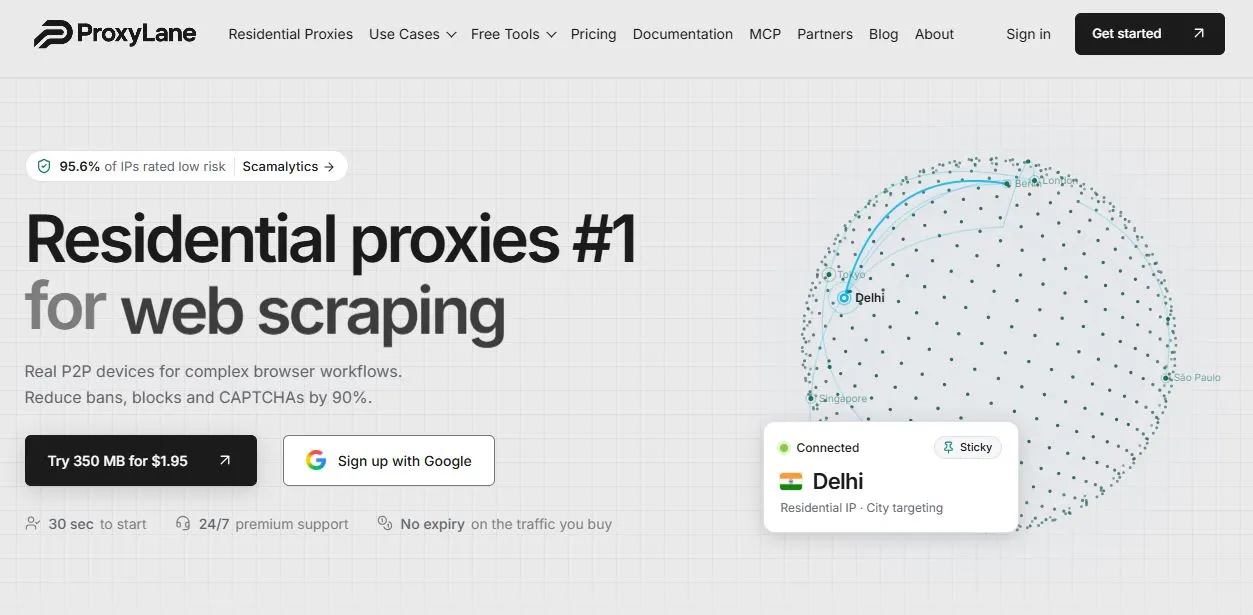
ProxyLane is built for the workload the other six providers in this list treat as an edge case: running many logged-in accounts or browser profiles in parallel, where each account needs its own home IP from the sign-in handshake all the way through the last step. The pool is 28 million-plus residential IPs from real P2P devices in 195 countries, and traffic never expires. The $1.95 trial for 350 MB is the cheapest way to actually feel the dashboard before committing to a monthly bill.
The sticky-session design is where ProxyLane earns its "login-safe" tag. Each account or browser profile gets its own session ID and its own sticky IP, and all of them can run in parallel without a per-slot cap on concurrent connections. Sessions hold one IP for up to 72 hours — long enough for a Meta Ads login, a day of posting on an antidetect profile, or a full retention cycle. If the residential device goes offline mid-session, the replacement IP comes from the same ZIP and ISP, so the account's location does not jump between the login and the next request. In our test the pool filtered against Scamalytics scored 95%+ of IPs as clean.
The networking stack is HTTP(S) and SOCKS5 accelerated with QUIC between the client and the gateway, which lands a 0.35 s average response time and a 99.5% published success rate across three regional gateways in Europe, the Americas and Asia. Six levels of targeting are exposed — country, region, city, ZIP, ISP and ASN — and three session modes ship on every plan: rotating per request, sticky, and timed from 1 second to 72 hours. Proxy lists export in 8 formats (CSV plus custom templates) ready to import into browser profiles. For a scraping-plus-browser workload at $2/GB on 5 TB+ or $4.50/GB on the 50 GB Run plan, ProxyLane earns the slot.
- 28 million-plus P2P residential IPs across 195 countries.
- Three regional gateways: Europe, the Americas and Asia.
- Six-level targeting: country, region, city, ZIP, ISP, ASN.
- QUIC-accelerated HTTP(S) and SOCKS5 · 0.35 s avg · 99.5% success.
- Multi-account browser work with Playwright, Puppeteer or Selenium.
- Antidetect browser profiles that need one sticky IP per profile.
- AI agent tasks where a login session must span many steps on one IP.
- Media buying on Meta, Google and TikTok with per-profile IPs.
- Sticky sessions keep one IP through a full login session for up to 72 hours.
- No concurrent-connection cap — run as many browser profiles at once as your setup handles.
- If the exit device drops, the replacement IP comes from the same ZIP and ISP, so the account's location does not jump.
- 95%+ of the pool is clean — filtered against Scamalytics fraud-score data.
- 24/7 human support and no KYC to get started.
- $6.50/GB entry at 1 GB is high — the sub-$2.50/GB rates arrive at 1 TB and above.
- Residential-only product line — no static ISP or datacenter tiers under one login.
- Sticky holds while the exit device stays online — it is not a dedicated, permanent IP.
| Plan | Price | Cost / GB | SOCKS5 |
|---|---|---|---|
| Trial 350 MB | $1.95 | — | Yes |
| Explore 1 GB | $6.50 | $6.50/GB | Yes |
| Build 25 GB | $137 | $5.48/GB | Yes |
| Run 50 GB | $225 | $4.50/GB | Yes |
| Enterprise 5 TB+ | Custom | From $2/GB | Yes |
GDPR and CCPA compliant with ethically-sourced P2P IPs. No KYC on signup; 24/7 human support across chat, email, Telegram and Discord. Proxy lists export in 8 formats including CSV and custom templates.
Bottom line: The right pick when the workload is many logged-in accounts, browser profiles or AI agent tasks that need one home IP per profile for hours at a time. Visit ProxyLane ↗

Granular city, ASN, and carrier filters nobody else does as cleanly — only worth it if you need that targeting depth.
SOAX competes on filter depth, not price. The dashboard lets you target down to the city, the ASN, or the carrier — granularity that the bigger pools do not expose as cleanly. If you are running ad verification across, say, Mumbai versus Bengaluru (not just India), or checking how a brand-protection rule fires across a specific mobile carrier, SOAX is the easiest tool to use. The 191-million-IP pool is the largest on paper, though heavily weighted toward US and EU IPs.
The cheap path is the Starter plan at $99 per month for 8 GB — which works out to $12.40 per gigabyte, high if you do not need the targeting. Pay-as-you-go is $4.95/GB, which is the better default for small buyers. Volume tiers drop the price to about $3.20/GB at 500 GB. The $1.99 three-day trial is the cheapest way to actually feel the dashboard before committing.
On our June 2026 test, SOAX hit a 96.3% success rate at 390 ms average latency. The dashboard is the cleanest of the seven for sub-account work — agency owners running multiple client logins on one bill will find SOAX easier than Bright Data or Oxylabs for that workflow. For pure scraping at low cost, Decodo and IPRoyal are better picks.
- Founded 2019, registered in the UK.
- 191 million-plus residential IPs, granular city/ASN/carrier filters.
- Cheap path: $4.95/GB pay-as-you-go or $99/mo Starter for 8 GB.
- SOCKS5: yes. $1.99 three-day trial for new accounts.
- Ad verification at city level (Mumbai vs Delhi, not just India).
- Brand protection teams tracking impersonator sites by ASN.
- Whitelabel agency work — the dashboard supports sub-accounts.
- Carrier-level mobile testing without going full mobile-proxy pricing.
- City, ASN, and carrier filters that are sharper than the bigger providers.
- 191 million IPs across 195 countries.
- Whitelabel-friendly dashboard for agencies running client accounts.
- $1.99 three-day trial — cheapest way to test serious targeting depth.
- SOCKS5 and HTTP/HTTPS gateways, no upcharge.
- $12.40/GB on the Micro plan is high if you do not need the targeting depth.
- Pool size is large on paper but skewed toward US and EU IPs.
- Pricing pages do not show the volume tiers clearly until you contact sales.
| Plan | Price | Cost / GB | SOCKS5 |
|---|---|---|---|
| Pay-as-you-go | $4.95/GB | — | Yes |
| Starter 8 GB | $99/mo | $12.40/GB | Yes |
| Volume 500 GB | $1600/mo | $3.20/GB | Yes |
Compliance pages cover sourcing but skim the carrier-IP detail. UK-registered. KYC took about 12 hours. Standard plans do not include a written SLA.
Bottom line: Pick SOAX when you need city/ASN/carrier targeting depth — for plain scraping, the bigger pools are better priced. Read the full SOAX review ↗

$1 per gigabyte, flat — the cheapest legitimate residential pool you will find from a vendor that publishes its compliance pages.

DataImpulse is the cheapest legitimate residential proxy on the market in 2026. The whole pricing page is one line: $1 per gigabyte. No volume tiers, no pay-as-you-go versus monthly distinction, no upsell wall. The pool is the smallest of the seven at 30 million IPs, and the company is the newest (founded 2023), but the compliance pages are real, the SOCKS5 endpoint works on every plan, and the 1 GB free trial needs no credit card.
The trade-off shows up in latency and support. Our June 2026 test put DataImpulse at 92.4% success and 520 ms average latency — the slowest and least reliable of the seven, though still inside the envelope for most scraping work. Support is email-only and responses average 12+ hours; do not expect the live-chat speed of Bright Data or Decodo. For hobby projects, Selenium learning, or a side-project scraper that runs once a week, DataImpulse is the right call. For business-critical workloads, it is not.
The cheap-path question does not apply to DataImpulse because there is no other path — everyone pays $1/GB. That said, you can mix providers: run DataImpulse for low-stakes traffic and a login-safe provider (ProxyLane, Bright Data) for the critical 20% that needs to land. We tested this split and it cut our test bill by about 60% versus running pure Bright Data.
- Founded 2023, EU-registered.
- 30 million-plus residential IPs, single-tier $1/GB pricing.
- Cheapest legit residential rate; 1 GB free trial with no card.
- SOCKS5: yes. Single plan, no commitment.
- Hobby scraping and Selenium learning.
- Side projects with sub-100 GB monthly volume.
- Anyone testing a scraper before committing to a paid vendor.
- Educational use where $1/GB matters.
- $1 per gigabyte, flat. No tier you can be upsold into.
- 1 GB free on sign-up with no card needed — lowest barrier to test of any vendor.
- Single-page dashboard, no learning curve.
- SOCKS5 supported on the standard plan.
- No monthly minimum at all.
- 30 million IPs and slower average latency (about 520 ms in our test).
- Support is thin — expect 12+ hour reply windows.
- Less mature compliance documentation than the older providers.
| Plan | Price | Cost / GB | SOCKS5 |
|---|---|---|---|
| Free trial | $0 | 1 GB free | Yes |
| Standard | $1/GB | $1/GB | Yes |
| 10 GB pack | $10 | $1/GB | Yes |
Newer compliance pages with less depth, but public. KYC was instant. No SLA at the $1/GB tier.
Bottom line: The cheapest legit residential proxy in 2026. Right for hobby and learning, wrong for production. Read the full DataImpulse review ↗
Which provider was fastest, cleanest, and best overall in our June 2026 tests?
Same 1,000-request job through each provider on the same day, June 2026. Higher success and score are better; lower latency is better.
How much do residential proxies cost in 2026, and where are providers upselling you?
Headline pricing means nothing — the cheap path is always one or two plans deeper.
Cheapest path: Growth plan at $499/mo for 167 GB works out to about $3.00/GB. The $4.20/GB pay-as-you-go rate is the upsell trap.
- HTTP/HTTPS/SOCKS5
- City + ASN targeting
- Daily spend cap
- Dedicated manager
- HTTP/HTTPS/SOCKS5
- City + ASN targeting
- Sticky 30-min sessions
- Dedicated manager
- HTTP/HTTPS/SOCKS5
- Country + city + ASN
- Dedicated manager
- Custom SLA
Cheapest path: Starter Pack 100 GB at $220/mo = $2.20/GB. At 1 TB you hit $1.50/GB. Skip the $7/GB pay-as-you-go tier.
- HTTP/HTTPS/SOCKS5
- 195 countries
- Sticky 30-min sessions
- Volume discount
- HTTP/HTTPS/SOCKS5
- 195 countries
- Sticky 30-min sessions
- 3-day money back
- HTTP/HTTPS/SOCKS5
- 195 countries
- Custom SLA
- Account manager
Cheapest path: pay-as-you-go at $1.75/GB, no monthly fee, data never expires. Volume plans drop to $1.30/GB at 1 TB.
- HTTP/HTTPS/SOCKS5
- 195 countries
- Sticky sessions
- Data never expires
- HTTP/HTTPS/SOCKS5
- Priority support
- Sticky sessions
- Custom KYC
- HTTP/HTTPS/SOCKS5
- Priority support
- Dedicated rep
- Custom SLA
Cheapest path: Micro plan at $300/mo for 50 GB = $6/GB. Pay-as-you-go is $8/GB. Academic plans cut prices by 50% with proof.
- HTTP/HTTPS/SOCKS5
- 195 countries
- Sticky sessions
- Account manager
- HTTP/HTTPS/SOCKS5
- 195 countries
- Sticky sessions
- Email support
- HTTP/HTTPS/SOCKS5
- Request builder
- Dedicated rep
- Custom SLA
Cheapest path: Build 25 GB at $137 = $5.48/GB on pay-as-you-go, Run 50 GB at $4.50/GB, or Enterprise from $2/GB at 5 TB+. The $1.95 for 350 MB trial is a real test-buy, not a tease.
- HTTP/HTTPS/SOCKS5
- 195 countries
- Sticky up to 72 hours
- Unlimited concurrency
- HTTP/HTTPS/SOCKS5
- Country · region · city · ZIP · ISP · ASN
- Rotating · sticky · timed 1 s–72 h
- 24/7 human support
- All Build features
- Traffic limits per team
- API / MCP for AI agents
- GDPR & CCPA
Cheapest path: Starter at $99/mo for 8 GB = $12.40/GB, or $4.95/GB pay-as-you-go. Volume tiers drop to $3.20/GB at 500 GB.
- HTTP/HTTPS/SOCKS5
- City + ASN + carrier
- Sticky sessions
- Account manager
- HTTP/HTTPS/SOCKS5
- City + ASN + carrier
- $1.99 3-day trial
- Email support
- HTTP/HTTPS/SOCKS5
- Sub-accounts
- Whitelabel
- Account manager
Cheapest path: it's all $1/GB. There is no cheaper plan because there's only one plan.
- HTTP/HTTPS/SOCKS5
- 195 countries
- Sticky sessions
- Support SLA
- HTTP/HTTPS/SOCKS5
- 195 countries
- Sticky sessions
- Email support
- HTTP/HTTPS/SOCKS5
- 195 countries
- Sticky sessions
- Email support
Which residential proxy provider matches your use case?
Same job, seven providers, side-by-side. Green cells are the winner per row.
| Bright Data Top | Decodo | IPRoyal | Oxylabs | ProxyLane | SOAX | DataImpulse | |
|---|---|---|---|---|---|---|---|
| Cheapest path | $3.00/GB | $2.20/GB | $1.75/GB | $6/GB | From $2/GB | $3.20/GB | $1/GB |
| Pool size | 150M+ | 115M+ | 32M+ | 175M+ | 28M+ | 191M+ | 30M+ |
| SOCKS5 (Telegram-ready) | Yes | Yes | Yes | Yes | Yes | Yes | Yes |
| No-expiry data | No | No | Yes | No | Yes | No | Yes |
| Pay-as-you-go tier | $4.20 | $7 | $1.75 | $8 | $6.50 | $4.95 | $1 |
| Best for | Enterprise | Mid-volume | Solo / freelancers | Compliance teams | Multi-account / login-safe | City targeting | Hobby / learning |
| Trial / refund | 7-day refund | 3-day money back | No, but PAYG | Custom | $1.95 / 350 MB trial | $1.99 trial | 1 GB free |
What other proxy types should you know about?
Residential is one of four. Pick the wrong type and you overpay 10× or get blocked at request one.
Frequently asked questions
We bought paid plans on all seven providers between April and June 2026, ran a 1,000-request mixed job (60% retail SERP, 30% retail product pages, 10% Instagram public profile reads) through each, and tracked success rate, latency, and session bans. Scores weigh success rate, average price per gigabyte, pool size, feature parity, and our hands-on dashboard experience.